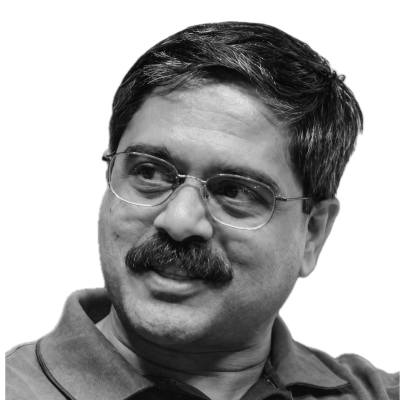
VenkatSubramaniam
Dr. Venkat Subramaniam is an award-winning author, founder of Agile Developer, Inc., creator of agilelearner.com, and an instructional professor at the University of Houston.
He has trained and mentored thousands of software developers in the US, Canada, Europe, and Asia, and is a regularly-invited speaker at several international conferences. Venkat helps his clients effectively apply and succeed with sustainable agile practices on their software projects.
Venkat is a (co)author of multiple technical books, including the 2007 Jolt Productivity award winning book Practices of an Agile Developer. You can find a list of his books at agiledeveloper.com. You can reach him by email at venkats@agiledeveloper.com or on twitter at @venkat_s.
We all have read good books that tell us to choose delegation over inheritance. Yet, we often choose inheritance? Why is that?
Architecture is not a static representation of a system. There are several complexities and risks involved in creating them. One way to mitigate the risk is to evolve the architecture. But, there are risks of evolving as much as there are the risks of not evolving. In this interactive workshop we will explore a set of practices that we can use to mitigate the risks. Then we will dive into discussing some common and popular architectural patterns.
Design patterns are commonplace in OO programming. With the introduction of lambda expressions in languages like Java, one has to wonder about their influence on design patterns.
Design patterns are commonplace in OO programming. With the introduction of lambda expressions in languages like Java, one has to wonder about their influence on design patterns.
Many developers around the world have jumped on the Microservices bandwagon. Several organizations, in the past and also in the present, have built around monolithic and also service oriented architectures. What separate, however, Microservices from those efforts at large? How does a Microservices based architecture influence the design of the software applications, what are the key design principles we should keep in mind, and how to leverage design goals like reuse and extensibility?
Game of Life is an intriguing game. At first look it looks simple, but as you look closer, it appears to be quite complex. How can we implement this game with different constraints, what are the constraints? Is it possible to use functional programming for this, to honor immutability? You see, it is intriguing.
Many developers aspire to become architects. Some of us serve currently as architects while the rest of us may hope to become one some day. We all have worked with architects, some good, and some that could be better. What are the traits of a good architect? What are the skills and qualities we should pick to become a very good one?
Continuous refactoring is critical to succeeding in projects and is an important part of sustainable agile development.
Continuous refactoring is critical to succeeding in projects and is an important part of sustainable agile development.
We all are familiar with SOLID and other software design principles and have explored many design patterns. There is no better way to get a deeper understanding than to practice the concepts. Furthermore, some of the principles and patterns manifest themselves in what appear to be rather unconventional ways when applied under a set of constraints and requirements.
We all are familiar with SOLID and other software design principles and have explored many design patterns. There is no better way to get a deeper understanding than to practice the concepts. Furthermore, some of the principles and patterns manifest themselves in what appear to be rather unconventional ways when applied under a set of constraints and requirements.
The vast majority of developers have experience creating monoliths. Whereas that experience is really good to have from the point of view of building monoliths, they may become a hindrance when creating microservices. There are a few things we have to do differently, we have to unlearn a few design principles, we have to adhere to a few different architectural goals, and yet carry forward some of the techniques that have worked well before.
Threads are considered lightweight but that's quite relative and in some context it appears to be rather heavyweight. The blocking nature of threads makes it rather unsuitable for asynchronous programming. That's the reason Java is introducing Virtual Threads.
The power of Java's functional programming goes far beyond lambdas and the filter, map of the Stream API. In this presentation we will look at various data transformations and see how the functional APIs in the JDK can provide concise solutions for these.
Zero fluff.